Our planet faces unprecedented environmental challenges, demanding innovative and effective management strategies. This guide delves into the core principles of environmental stewardship, exploring sustainable practices, pollution prevention, and resource conservation. We’ll examine the intricate web of environmental systems and how human actions impact them, showcasing successful global initiatives and contrasting various management approaches.
From designing robust Environmental Management Systems (EMS) for businesses to tackling climate change and pollution, we’ll equip you with the knowledge and tools to make a real difference. We’ll explore the crucial role of environmental impact assessments (EIAs), the benefits of utilizing environmental management software, and the importance of understanding waste management hierarchies. This guide is your comprehensive resource for navigating the complexities of environmental responsibility.
Understanding Environmental Principles
Effective environmental management hinges on a solid understanding of core principles that guide sustainable practices and minimize human impact on the planet. These principles are interconnected and require a holistic approach to achieve meaningful and lasting positive change.
Sustainability
Sustainability is the overarching principle, aiming to meet the needs of the present without compromising the ability of future generations to meet their own needs. This involves balancing environmental, social, and economic considerations. It’s not simply about preserving nature; it’s about ensuring a thriving and equitable future for all. For example, sustainable forestry practices involve harvesting timber at a rate that allows forests to regenerate, ensuring a continuous supply of wood while maintaining biodiversity and ecosystem health. Sustainable agriculture focuses on methods that minimize environmental impact while ensuring food security, such as crop rotation and reduced pesticide use.
Pollution Prevention
Pollution prevention prioritizes avoiding the creation of pollution in the first place, rather than focusing solely on cleaning it up afterward. This proactive approach is more efficient and cost-effective in the long run. Strategies include designing products and processes to minimize waste and emissions, using cleaner production technologies, and promoting responsible consumption patterns. The transition to electric vehicles, for instance, significantly reduces air pollution compared to gasoline-powered cars. Similarly, implementing stricter regulations on industrial emissions can drastically reduce water and air contamination.
Resource Conservation
Resource conservation involves using natural resources efficiently and responsibly, minimizing waste and maximizing the lifespan of products and materials. This encompasses water conservation, energy efficiency, and the reduction of material consumption through recycling and reuse. Examples include implementing water-saving irrigation techniques in agriculture, using energy-efficient appliances in homes and businesses, and promoting the use of recycled materials in manufacturing. The development and adoption of circular economy models, which prioritize reuse, repair, and recycling, represent a significant advancement in resource conservation.
Interconnectedness of Environmental Systems
Environmental systems are intricately linked. Changes in one area can have cascading effects throughout the entire system. For example, deforestation in one region can lead to soil erosion, impacting water quality downstream and contributing to climate change globally. Human activities, particularly industrialization and urbanization, have significantly altered these systems, often with negative consequences. Understanding these interconnections is crucial for developing effective environmental management strategies.
Examples of Successful Environmental Management Strategies
The Montreal Protocol, an international treaty phasing out ozone-depleting substances, is a prime example of successful global environmental cooperation. It has demonstrably reduced the depletion of the ozone layer, protecting human health and the environment. Similarly, the establishment of protected areas and national parks worldwide has contributed to biodiversity conservation and ecosystem preservation. These successes highlight the importance of international collaboration and the effectiveness of well-designed policies and regulations.
Comparison of Environmental Management Approaches
| Approach | Mechanism | Advantages | Disadvantages |
|---|---|---|---|
| Command and Control | Regulations and enforcement | Clear standards, relatively easy to implement | Can be inflexible, may stifle innovation, potentially high compliance costs |
| Market-Based | Economic incentives (e.g., carbon taxes, cap-and-trade) | Cost-effective, encourages innovation, flexibility | Requires robust monitoring and enforcement, potential for market manipulation |
Implementing Environmental Management Systems
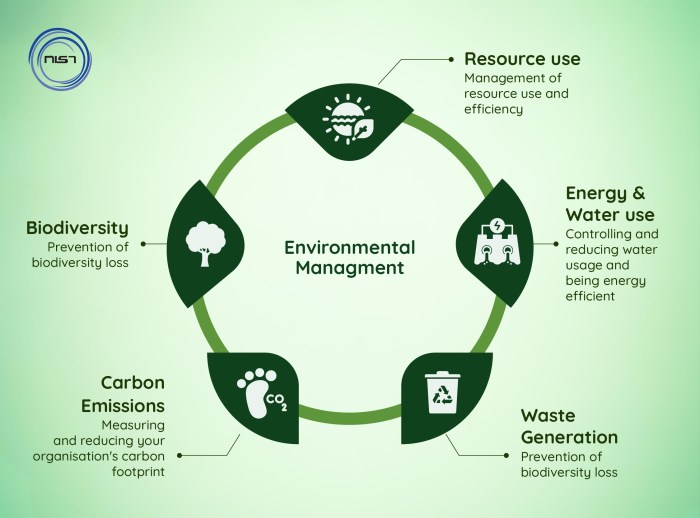
Effective environmental management is crucial for any organization, particularly manufacturing companies, to minimize their ecological footprint and ensure sustainable operations. A well-designed Environmental Management System (EMS) provides a framework for achieving these goals, leading to improved efficiency, reduced costs, and enhanced reputation. This section details the key aspects of implementing such a system, including audits, assessments, and the role of ISO 14001.
Designing an Effective Environmental Management System for a Hypothetical Manufacturing Company
Let’s consider “GreenTech Manufacturing,” a hypothetical company producing solar panels. Their EMS would begin with a comprehensive environmental policy statement, clearly outlining their commitment to environmental stewardship. This would be followed by identifying significant environmental aspects – energy consumption, water usage, waste generation (including hazardous waste), and greenhouse gas emissions – through a thorough environmental review. Subsequently, GreenTech would establish environmental objectives and targets, for example, reducing water consumption by 15% within two years and achieving zero waste to landfill within five years. These targets would be supported by a robust set of operational controls and procedures, ensuring compliance with relevant environmental regulations and industry best practices. Regular monitoring and review mechanisms would track progress towards these objectives and identify areas for improvement. Finally, GreenTech would establish a system for documenting all aspects of their EMS, including training records for employees and audit reports.
Best Practices for Conducting Environmental Audits and Assessments
Environmental audits and assessments are vital components of any effective EMS. Best practices involve using a systematic approach, employing a qualified and independent audit team, and following a pre-defined checklist or audit protocol. The audit should cover all aspects of the EMS, including compliance with legal requirements, effectiveness of controls, and the accuracy of environmental performance data. Assessments should go beyond simple compliance checks, analyzing potential environmental risks and opportunities. For instance, a thorough assessment might reveal energy efficiency improvements or identify potential sources of pollution that require mitigation. The findings of both audits and assessments should be documented in detailed reports, including recommendations for corrective and preventive actions. Follow-up audits are crucial to verify the implementation of corrective actions and ensure continuous improvement.
The Role of Environmental Impact Assessments (EIAs) in Project Planning
Environmental Impact Assessments (EIAs) are crucial for proactively identifying and mitigating the potential environmental consequences of new projects or developments. They are typically mandated by government regulations for projects exceeding certain thresholds. An EIA involves a detailed assessment of the potential impacts of a project on various environmental components, including air and water quality, biodiversity, and land use. It involves baseline data collection, impact prediction using modeling or other appropriate techniques, and the development of mitigation measures to minimize negative impacts. For example, an EIA for a new highway project might assess its impact on wildlife habitats and propose measures such as wildlife crossings to minimize disruption. The EIA report is a critical input into the decision-making process, informing stakeholders and decision-makers about the environmental implications of the project.
A Step-by-Step Guide for Implementing an ISO 14001 Compliant EMS
Implementing an ISO 14001 compliant EMS involves a structured approach. First, establish a commitment and policy from top management, clearly outlining environmental goals. Next, identify environmental aspects and impacts through a thorough review of operations. Then, develop objectives and targets, making them measurable, achievable, relevant, and time-bound (SMART). Implement the necessary operational controls to achieve these targets. Develop and implement an environmental monitoring and measurement program to track performance. Conduct internal audits to verify the effectiveness of the EMS. Establish a management review process to assess the overall performance and make improvements. Finally, seek ISO 14001 certification to demonstrate a commitment to environmental best practices.
Benefits of Using Environmental Management Software
Environmental management software offers significant benefits in streamlining EMS operations. These systems can automate data collection, analysis, and reporting, reducing the manual effort required for tasks such as tracking emissions, waste generation, and energy consumption. They can also facilitate compliance monitoring, ensuring adherence to environmental regulations. Many software packages provide dashboards and reporting tools, offering real-time insights into environmental performance, enabling proactive identification of areas for improvement. Furthermore, these systems can enhance communication and collaboration within the organization and with external stakeholders, facilitating better environmental management practices. Examples include software that tracks carbon footprint, manages waste streams, or helps with regulatory compliance reporting.
Addressing Key Environmental Challenges
Effective environmental management necessitates a proactive approach to addressing the most pressing global challenges. This section explores key environmental issues, outlining their causes and proposing strategies for mitigation and adaptation. Understanding these challenges is crucial for developing and implementing effective environmental management systems.
Climate Change Mitigation and Adaptation Strategies
Climate change, driven primarily by greenhouse gas emissions from human activities, presents a significant threat to ecosystems and human societies. Mitigation strategies focus on reducing greenhouse gas emissions through transitioning to renewable energy sources, improving energy efficiency, and adopting sustainable land-use practices. For example, the European Union’s Emissions Trading System (ETS) exemplifies a cap-and-trade approach to reducing industrial emissions. Adaptation strategies, on the other hand, focus on adjusting to the unavoidable impacts of climate change, such as sea-level rise and extreme weather events. Coastal communities, for instance, are implementing strategies like building seawalls and developing early warning systems for storms. A combination of both mitigation and adaptation is necessary for effective climate change management.
Sources and Solutions for Air, Water, and Soil Pollution
Major sources of air pollution include industrial emissions, vehicle exhaust, and agricultural activities. Solutions involve implementing stricter emission standards for industries and vehicles, promoting the use of cleaner fuels, and adopting sustainable agricultural practices. Water pollution stems from industrial discharge, agricultural runoff, and sewage. Solutions include upgrading wastewater treatment plants, implementing stricter regulations on industrial discharge, and promoting sustainable agricultural practices that minimize runoff. Soil pollution is primarily caused by industrial waste, agricultural chemicals, and improper waste disposal. Solutions involve implementing stricter regulations on waste disposal, promoting sustainable agricultural practices, and implementing soil remediation techniques.
Renewable Energy Technologies and Their Environmental Impacts
Renewable energy technologies offer a sustainable alternative to fossil fuels. Solar power harnesses sunlight using photovoltaic cells or concentrated solar power systems. Wind power utilizes wind turbines to generate electricity. Hydropower utilizes the energy of flowing water to generate electricity. Geothermal energy harnesses heat from the Earth’s interior. Bioenergy utilizes biomass to generate energy. Each technology has its own environmental impacts; for example, solar and wind power have minimal ongoing environmental impacts but require land use and material resources for manufacturing. Hydropower can affect river ecosystems, while bioenergy can have impacts depending on the source and management of biomass. A holistic assessment of environmental impacts is crucial for responsible renewable energy deployment.
Waste Management Hierarchies and Their Application
Waste management hierarchies prioritize waste reduction, reuse, recycling, and recovery before disposal. Waste reduction involves minimizing the amount of waste generated. Reuse involves finding alternative uses for materials before disposal. Recycling involves processing waste materials to create new products. Recovery involves extracting energy or valuable materials from waste. Disposal, the least preferred option, involves landfilling or incineration. Implementing a waste management hierarchy requires comprehensive waste collection and sorting systems, as well as robust recycling and recovery infrastructure. The success of such systems depends on public participation and policy support.
Product Lifecycle and Environmental Footprint
Caption: The Environmental Footprint of a T-Shirt – From Raw Material to Disposal
The image depicts a circular flow diagram illustrating the lifecycle of a cotton t-shirt. The first stage shows cotton cultivation, highlighting the use of land, water, and pesticides. The second stage depicts the manufacturing process, including spinning, weaving, dyeing, and sewing, showcasing energy consumption and waste generation. The third stage represents the product’s use phase, highlighting its lifespan and potential for reuse or repair. The final stage shows the disposal phase, indicating options like landfill, incineration, or recycling. The diagram visually represents the overall environmental impact of the product throughout its lifecycle, encompassing resource consumption, emissions, and waste generation at each stage. Arrows connecting each stage show the flow of materials and energy. Different colors might be used to represent different environmental impacts (e.g., water use in blue, carbon emissions in grey). The diagram clearly demonstrates the cumulative environmental footprint associated with the product and emphasizes the importance of considering the entire lifecycle when assessing sustainability.
Concluding Remarks
Ultimately, effective environmental management requires a multifaceted approach, integrating scientific understanding with practical implementation. By embracing sustainable practices, implementing robust EMS, and addressing key environmental challenges proactively, we can safeguard our planet’s future. This guide provides a framework for understanding and acting upon this critical responsibility, empowering individuals and organizations to contribute to a healthier and more sustainable world. The journey towards environmental stewardship is a continuous process of learning, adapting, and innovating – a journey we hope this guide helps you navigate successfully.