Effective leadership is the cornerstone of any successful organization, yet the qualities that define a truly great leader often remain elusive. This exploration delves into five essential characteristics – vision, communication, integrity, adaptability, and empathy – examining how these traits contribute to building strong teams, achieving ambitious goals, and navigating complex challenges. We’ll uncover practical strategies and real-world examples to illustrate the impact of these qualities on leadership effectiveness.
Understanding these core principles is crucial not only for aspiring leaders but also for team members seeking to enhance their collaboration and contribute meaningfully to their organizations. By analyzing successful leadership models and identifying potential pitfalls, we aim to provide a comprehensive understanding of what it takes to excel in today’s dynamic environment.
Vision and Strategic Thinking
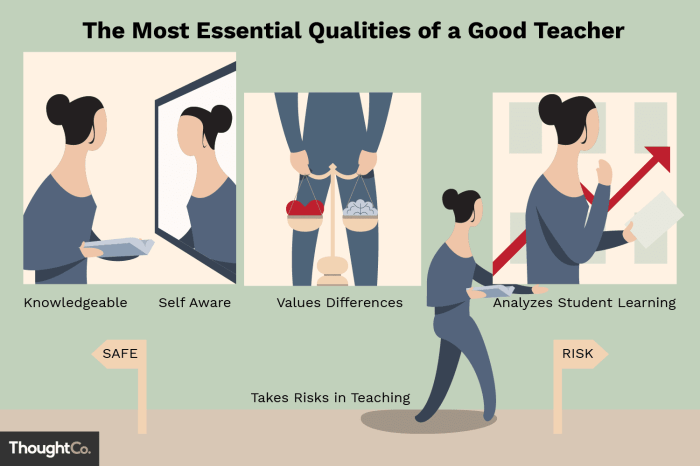
A compelling vision is the cornerstone of effective leadership. It’s more than just a goal; it’s a clear, concise, and inspiring picture of a desired future state that motivates and guides individuals and teams. Leaders with this capability articulate a vision that resonates with their followers, fostering a shared sense of purpose and direction. This vision provides a framework for decision-making and action, ensuring everyone is working towards a common objective.
Leaders translate their vision into actionable strategies through a methodical process of planning and execution. This involves breaking down the overall vision into smaller, manageable goals, identifying the necessary resources, and developing a timeline for achieving each milestone. Effective communication is crucial in this phase, ensuring that everyone understands their role and how their contributions fit into the larger picture.
Adapting strategies in response to changing circumstances is paramount for long-term success. The ability to remain flexible and adjust plans based on new information, unforeseen challenges, or evolving market conditions is a hallmark of strong leadership. This requires continuous monitoring of the environment, a willingness to reassess priorities, and the courage to make necessary changes. Ignoring shifts in the landscape can lead to stagnation and ultimately, failure.
Consider a scenario where a company’s CEO envisioned a significant expansion into a new market without adequately researching the competitive landscape or the potential economic risks. Their rigid adherence to the initial vision, despite clear warning signs of market saturation and escalating costs, ultimately led to substantial financial losses and a significant downturn for the company. The failure to adapt the expansion strategy based on real-time feedback demonstrated a critical leadership flaw.
Effective and Ineffective Vision-Setting Techniques
A leader’s ability to effectively set a vision is crucial for organizational success. The following table compares effective and ineffective techniques:
| Effective Vision-Setting | Ineffective Vision-Setting |
|---|---|
| Clearly defined and concise vision statement, easily understood by all stakeholders. | Vague, ambiguous, and overly complex vision statement, difficult to understand and implement. |
| Collaborative vision development, involving input from various levels of the organization. | Top-down approach, with limited or no input from employees. |
| Regular communication and feedback mechanisms to ensure alignment and address concerns. | Lack of communication and feedback, leading to confusion and disengagement. |
| Measurable goals and objectives, allowing for progress tracking and adjustments. | Unmeasurable goals and objectives, making it difficult to assess progress and make necessary changes. |
Communication and Interpersonal Skills
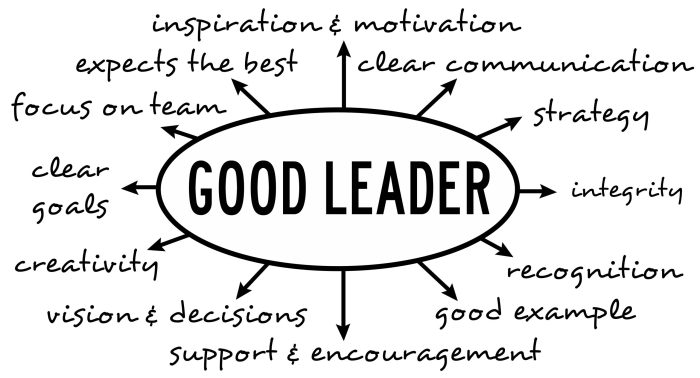
Effective communication and strong interpersonal skills are cornerstones of successful leadership. A leader’s ability to clearly convey information, actively listen to others, and build rapport significantly impacts team morale, productivity, and overall success. These skills are not innate; they are developed and honed through practice and self-awareness.
Effective Communication Techniques for Building Trust
Building trust within a team requires consistent and transparent communication. Leaders should prioritize open dialogue, ensuring that information flows freely in both directions. This includes being upfront about challenges, celebrating successes openly, and actively soliciting feedback. Regular team meetings, both formal and informal, provide opportunities for open communication and relationship building. Furthermore, using clear and concise language, avoiding jargon, and tailoring communication to the audience’s understanding are crucial for fostering trust and ensuring everyone is on the same page. For example, a leader might use visual aids during a presentation to ensure complex data is easily understood by all team members.
Active Listening in Leader-Follower Relationships
Active listening goes beyond simply hearing; it involves fully concentrating on what the speaker is saying, understanding their perspective, responding thoughtfully, and remembering the conversation. This demonstrates respect and creates a safe space for open communication. Active listening strengthens leader-follower relationships by building trust, improving understanding, and fostering collaboration. A leader who actively listens is better equipped to address team members’ concerns, understand their motivations, and provide appropriate support. For instance, paraphrasing what a team member has said, asking clarifying questions, and offering verbal and non-verbal cues (such as nodding and maintaining eye contact) all demonstrate active listening and encourage open dialogue.
Common Communication Barriers and Their Solutions
Several barriers can hinder effective communication within teams. These include physical distractions (noisy environments), psychological barriers (preconceived notions, biases), semantic barriers (misunderstandings due to differing interpretations of words), and cultural differences (varying communication styles). Leaders can overcome these barriers by creating a conducive communication environment, actively seeking to understand diverse perspectives, clarifying ambiguous language, and using multiple communication channels to reinforce messages. For example, a leader might schedule meetings in quiet spaces, encourage active participation from all team members, and utilize both verbal and written communication to ensure clarity and understanding.
Delivering Constructive Feedback for Growth
Constructive feedback focuses on specific behaviors and their impact, rather than making personal attacks. It should be delivered in a timely, private setting, using the “Situation-Behavior-Impact” (SBI) model. This involves describing the specific situation, outlining the observed behavior, and explaining the impact of that behavior. For instance, instead of saying “You’re always late,” a leader might say, “During the last two project meetings, you arrived 15 minutes late. This caused a delay in starting the meeting and prevented us from fully utilizing the allocated time.” Following the feedback with suggestions for improvement and a supportive tone is crucial for fostering growth and development.
Communication Styles and Their Effectiveness
The effectiveness of different communication styles varies depending on the context and the audience.
- Assertive Communication: Expressing one’s needs and opinions clearly and respectfully, while considering others’ perspectives. This style is generally highly effective in most professional settings.
- Passive Communication: Avoiding expressing one’s needs and opinions, often leading to resentment and misunderstandings. This style is generally ineffective and can damage relationships.
- Aggressive Communication: Expressing one’s needs and opinions in a hostile or demanding manner, often leading to conflict. This style is rarely effective and can be highly damaging to relationships.
- Passive-Aggressive Communication: Expressing negative feelings indirectly, often through subtle actions or behaviors. This style is generally ineffective and can create confusion and distrust.
Understanding these styles and adapting one’s approach accordingly is crucial for effective leadership.
Integrity and Ethical Conduct
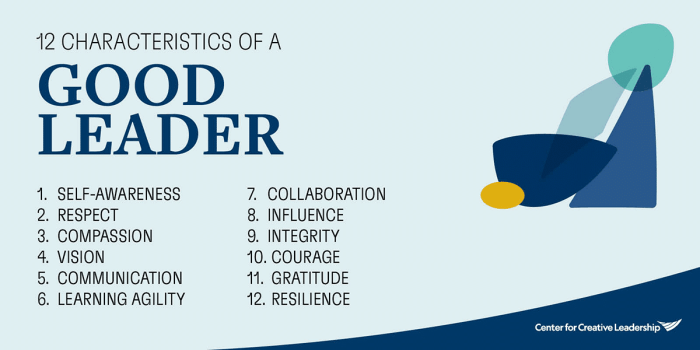
Integrity and ethical conduct are cornerstones of effective leadership. A leader’s ethical behavior profoundly influences the trust and respect they earn from their team, directly impacting overall performance and organizational success. Ethical decision-making isn’t simply about avoiding legal repercussions; it’s about building a culture of fairness, responsibility, and accountability.
Ethical decision-making in leadership is paramount because it fosters trust, builds strong relationships, and creates a positive work environment. When leaders consistently act with integrity, their teams are more likely to be engaged, motivated, and productive. Conversely, unethical behavior can severely damage team morale, productivity, and the organization’s reputation. This section will explore the importance of ethical leadership, examine examples of ethical leaders, compare different ethical frameworks, and demonstrate the impact of a leader’s actions on team dynamics.
Examples of Leaders Demonstrating Strong Ethical Principles
Leaders who consistently exhibit strong ethical principles inspire trust and loyalty within their teams. Consider Nelson Mandela, whose unwavering commitment to justice and equality, even during his long imprisonment, served as a powerful example of ethical leadership. His actions inspired a nation and continue to resonate globally as a testament to the transformative power of ethical conduct. Another example is Abraham Lincoln, who navigated the complex moral challenges of the American Civil War with a steadfast commitment to preserving the Union while fighting for the abolition of slavery. His leadership demonstrated a profound understanding of ethical responsibility in the face of immense pressure. These leaders, despite facing immense challenges, prioritized ethical principles, shaping their legacies and influencing countless others.
Comparison of Ethical Frameworks Relevant to Leadership
Several ethical frameworks can guide leaders in their decision-making. Utilitarianism, for instance, focuses on maximizing overall happiness and well-being, while deontology emphasizes adherence to moral duties and rules regardless of the consequences. Virtue ethics, on the other hand, centers on cultivating virtuous character traits like honesty, fairness, and compassion. Each framework offers a unique perspective on ethical decision-making, and leaders may find it beneficial to draw upon elements from multiple frameworks to navigate complex ethical dilemmas. The choice of framework is not always explicit; often, a leader’s ingrained values and experiences inform their ethical decision-making process, even unconsciously drawing upon different ethical perspectives.
Impact of a Leader’s Actions on Team Morale and Productivity
A leader’s actions directly impact team morale and productivity. When a leader consistently demonstrates integrity and ethical conduct, team members feel valued, respected, and empowered. This fosters a culture of trust and collaboration, leading to increased engagement, motivation, and productivity. Conversely, unethical behavior by a leader can severely damage team morale, create distrust, and lead to decreased productivity. For example, if a leader consistently favors certain team members or engages in unfair practices, it can create resentment and conflict, undermining team cohesion and performance. The ripple effect of a leader’s ethical or unethical actions extends far beyond the immediate team, impacting the entire organization.
Hypothetical Scenario: An Ethical Dilemma and Leader Response
Imagine a scenario where a project manager discovers a critical flaw in a product nearing launch. Releasing the product as is would risk significant harm to customers, but delaying the launch would cause considerable financial losses and potentially jeopardize the company’s reputation. An ethically responsible leader would prioritize customer safety and transparency. They would initiate a thorough investigation into the flaw, work with the development team to find a solution, and communicate transparently with stakeholders, including customers, about the issue and the steps being taken to rectify it. This response prioritizes ethical considerations over short-term gains, ultimately building trust and strengthening the company’s long-term reputation.
Final Conclusion
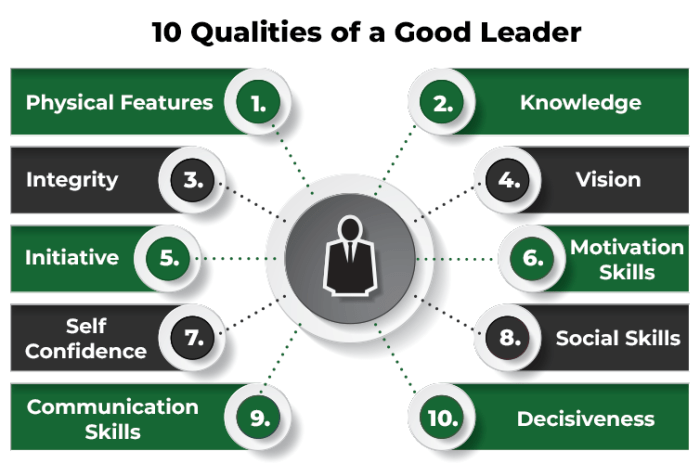
In conclusion, the five essential qualities of a good leader—vision, communication, integrity, adaptability, and empathy—are interconnected and mutually reinforcing. Cultivating these traits requires ongoing self-reflection, a commitment to continuous learning, and a genuine desire to serve and empower others. By embracing these principles, leaders can build high-performing teams, foster a positive and productive work environment, and ultimately achieve lasting success. The journey to becoming a truly effective leader is a continuous process of growth and development, demanding both self-awareness and a dedication to ethical conduct.