Successfully navigating the complexities of managing a remote team requires a nuanced understanding of communication, collaboration, performance, and cultural cohesion. The shift to remote work has presented both unprecedented opportunities and unique challenges, demanding innovative strategies to maintain productivity, engagement, and a strong team identity. This exploration delves into four key challenges inherent in managing remote teams, offering practical solutions and actionable strategies to overcome them.
From mitigating communication breakdowns and fostering team cohesion across geographical boundaries to effectively managing performance and productivity in a virtual environment, this guide provides a comprehensive framework for building and leading high-performing remote teams. We will examine best practices for communication protocols, collaborative tool selection, performance evaluation, and team-building activities specifically designed for remote settings. The goal is to equip managers with the tools and knowledge necessary to create a thriving and productive remote workforce.
Communication Breakdown in Remote Teams
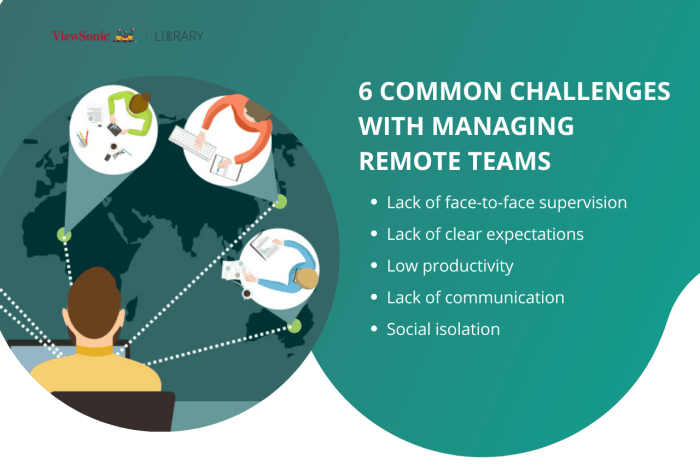
Effective communication is the bedrock of any successful team, but the challenges are amplified in remote environments. Distance, differing time zones, and the lack of spontaneous interactions can create significant hurdles. Understanding and addressing these communication barriers is crucial for building a cohesive and productive remote team.
Common Communication Barriers in Remote Teams
Three common communication barriers frequently hinder remote team performance: a lack of non-verbal cues, the potential for misinterpretations in written communication, and difficulties in maintaining a sense of team cohesion. Overcoming these requires a proactive and multifaceted approach. Firstly, the absence of face-to-face interaction means crucial non-verbal cues, like body language and tone of voice, are lost. This can lead to misunderstandings and misinterpretations. Secondly, written communication, while efficient, is prone to ambiguity. The lack of immediate feedback can result in messages being misinterpreted or overlooked. Finally, the physical separation can lead to feelings of isolation and disconnect among team members, impacting morale and collaboration.
Strategies to Overcome Communication Barriers
To mitigate these challenges, several strategies can be implemented. Encouraging the use of video conferencing for regular meetings helps restore some of the lost non-verbal cues. Using clear and concise language in written communication, avoiding jargon and ambiguity, is essential. Regular social interaction, such as virtual coffee breaks or team-building activities, can help maintain team cohesion and foster a stronger sense of community. Active listening and seeking clarification when needed are also crucial for ensuring messages are understood correctly.
Synchronous and Asynchronous Communication Methods
Choosing the right communication method is critical for efficient remote teamwork. The table below compares synchronous and asynchronous approaches:
| Method | Advantages | Disadvantages | Best Use Cases |
|---|---|---|---|
| Video Conferencing | Real-time interaction, non-verbal cues, immediate feedback | Requires scheduling, time zone constraints, technical difficulties | Urgent matters, brainstorming sessions, team meetings |
| Instant Messaging | Quick communication, informal, readily available | Can be overwhelming, easily misinterpreted, lacks context | Quick questions, informal updates, collaboration on small tasks |
| Formal record, asynchronous, suitable for detailed information | Slow response time, can get lost in inboxes, lacks immediacy | Formal announcements, detailed instructions, project updates | |
| Project Management Software | Centralized platform, task management, progress tracking | Requires team buy-in, can be complex to set up, needs regular updates | Project tracking, task delegation, progress monitoring |
Establishing Clear Communication Protocols and Expectations
Clear communication protocols are essential for ensuring consistent and effective information flow. This includes defining preferred communication methods for different situations, establishing response times, and outlining procedures for handling urgent issues. For instance, a team might agree to use instant messaging for quick questions, email for formal announcements, and video conferencing for regular team meetings. Clearly defined response times, such as replying to emails within 24 hours, help manage expectations and prevent communication delays.
Sample Communication Plan for a Remote Team
A well-defined communication plan Artikels how different communication situations will be handled. This plan should be accessible to all team members and regularly reviewed.
| Communication Type | Method | Frequency | Responsible Party | Escalation Path |
|—|—|—|—|—|
| Urgent Issues | Instant Messaging/Video Conference | Immediately | Team Lead/Designated Contact | Direct supervisor, if needed |
| Routine Updates | Email/Project Management Software | Daily/Weekly | Project Manager/Team Member | Team Lead, if needed |
| Feedback Sessions | Video Conference/One-on-One Calls | Weekly/Bi-weekly | Team Lead/Manager | HR, if needed |
Maintaining Team Cohesion and Collaboration

Maintaining a strong sense of team cohesion and collaboration is crucial for the success of any remote team. Geographical distance can easily lead to feelings of isolation and disconnect, hindering productivity and overall team morale. Therefore, proactive measures are essential to foster a supportive and engaging work environment. This section will explore practical strategies to cultivate a strong sense of community and effective collaboration among geographically dispersed team members.
Practical Activities to Foster Team Cohesion
Building camaraderie among remote team members requires a deliberate and consistent effort. Regular engagement in activities designed to promote interaction and shared experiences can significantly improve team cohesion. The following activities offer diverse approaches to achieve this goal.
- Virtual Coffee Breaks/Lunch Breaks: Scheduling informal virtual gatherings allows for casual conversation and relationship building outside of formal work tasks. These can be facilitated through video conferencing platforms, encouraging spontaneous interactions and personal connections.
- Team-Based Online Games: Engaging in online games, such as virtual escape rooms or collaborative puzzle games, can promote teamwork and problem-solving skills in a fun and relaxed setting. These activities foster collaboration and shared success experiences.
- Shared Online Spaces: Creating dedicated online spaces, such as a team Slack channel or a shared online forum, dedicated to non-work-related discussions and shared interests can foster a sense of community. This encourages informal communication and allows team members to connect on a personal level.
- Virtual Team Outings: Organizing virtual team events, such as online movie nights or virtual happy hours, creates opportunities for team members to socialize and interact outside of work hours. These events can be tailored to the team’s interests and preferences.
- Recognition and Appreciation Programs: Publicly acknowledging and appreciating team members’ contributions, both big and small, can boost morale and foster a sense of belonging. This can be done through online platforms, team emails, or during virtual meetings.
Comparison of Collaborative Tools for Remote Teams
Selecting the right collaborative tools is paramount for effective remote teamwork. Different tools cater to various needs and preferences. The following table compares several popular options:
| Tool | Features | Pros | Cons |
|---|---|---|---|
| Slack | Instant messaging, file sharing, channels, integrations | Real-time communication, easy to use, extensive integrations | Can become cluttered, free version has limitations |
| Microsoft Teams | Instant messaging, video conferencing, file sharing, project management tools | Integrated with other Microsoft products, robust features | Can be complex for smaller teams, requires Microsoft ecosystem |
| Asana | Project management, task assignment, progress tracking, communication features | Excellent for project organization and tracking, clear task assignments | Steeper learning curve than some other tools, can be overly complex for simple projects |
| Trello | Kanban board, task management, visual workflow | Visual and intuitive interface, easy to use for basic project management | Limited features compared to more comprehensive project management tools |
| Google Workspace (including Google Chat, Docs, Meet) | Real-time collaboration on documents, video conferencing, instant messaging | Seamless integration between tools, widely used and familiar to many | Can be challenging to manage permissions and access for large teams |
Virtual Team-Building Event Plan
Regular virtual team-building events are essential for maintaining team cohesion and morale. The following plan Artikels three examples, each with different goals and activities:
- Event 1: Icebreaker & Get-to-Know-You Session (Goal: Enhance Team Bonding)
- Activity: Online personality quiz followed by a casual video conference where team members share their results and discuss commonalities.
- Expected Outcome: Improved team rapport, increased understanding of team members’ personalities and preferences.
- Event 2: Virtual Escape Room (Goal: Improve Collaboration & Problem-Solving Skills)
- Activity: Participation in a collaborative online escape room, requiring teamwork and communication to solve puzzles and escape.
- Expected Outcome: Strengthened teamwork skills, improved communication and problem-solving abilities, increased team cohesion.
- Event 3: Virtual Team Lunch & Learn (Goal: Knowledge Sharing & Professional Development)
- Activity: A team member presents on a topic of interest related to their expertise or a relevant industry trend, followed by Q&A and discussion.
- Expected Outcome: Increased knowledge sharing, professional development opportunities, strengthened team relationships through shared learning.
Managing Performance and Productivity in Remote Settings
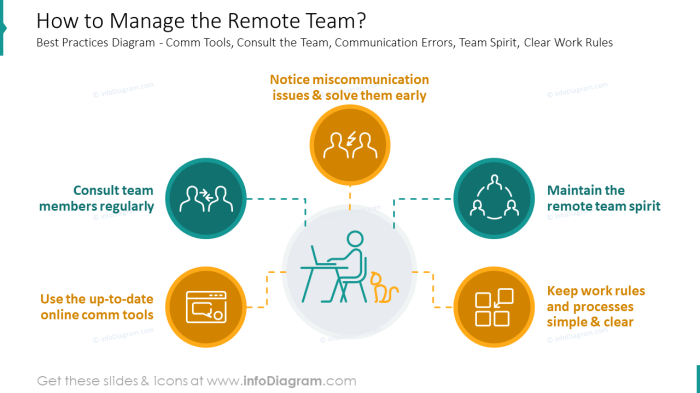
Successfully managing performance and productivity within a remote team requires a shift in approach compared to traditional in-office environments. It necessitates a focus on measurable outcomes, transparent communication, and a supportive feedback culture. This section will Artikel key strategies for effectively monitoring and improving remote team performance.
Key Performance Indicators for Remote Teams
Selecting the right Key Performance Indicators (KPIs) is crucial for accurately assessing individual and team performance in a remote setting. These KPIs should be specific, measurable, achievable, relevant, and time-bound (SMART). Focusing on output rather than simply hours worked is essential.
- Project Completion Rate: This measures the percentage of assigned projects completed on time and to the specified quality standards. Tracking this KPI involves establishing clear project deadlines and quality benchmarks at the outset, then monitoring progress against these targets using project management software. Regular progress reports and check-ins help maintain accountability.
- Quality of Work: This assesses the accuracy, completeness, and overall quality of the work produced. This can be measured through client feedback, internal reviews, error rates, and adherence to established quality control procedures. Implementing a robust quality assurance process, including peer reviews and self-assessment, is crucial for effective monitoring.
- Client Satisfaction: In many remote teams, client interaction is paramount. This KPI measures client satisfaction with the services or products delivered. Regular client surveys, feedback forms, and performance reviews provide valuable insights into how well the team is meeting client expectations. This data can inform improvements in processes and service delivery.
Providing Constructive Feedback to Remote Team Members
Effective feedback is vital for remote team members’ growth and performance improvement. It should be delivered regularly, focusing on both strengths and areas for development. Constructive feedback should be specific, actionable, and timely, delivered in a supportive and encouraging manner.
- Sample Feedback Framework:
- Start with the positive: Acknowledge the individual’s contributions and achievements. For example, “Your recent presentation to the client was excellent, and they were particularly impressed with your insightful analysis.”
- Identify areas for improvement: Clearly and specifically describe areas where performance can be enhanced. For example, “While your analysis was strong, the report could benefit from clearer organization and more concise writing.”
- Offer specific suggestions: Provide actionable steps the individual can take to improve. For example, “Consider using bullet points and subheadings to improve the report’s structure, and aim for a more concise writing style by focusing on key points.”
- Set clear expectations: Artikel specific goals and timelines for improvement. For example, “Let’s aim for a revised report by [date], incorporating these suggestions. We can schedule a follow-up meeting to discuss your progress.”
- End on a positive and supportive note: Reiterate your confidence in the individual’s abilities and offer your continued support. For example, “I’m confident you can achieve these improvements. Please don’t hesitate to reach out if you need any assistance.”
Conducting Effective Remote Performance Reviews
Remote performance reviews should be a structured process designed to assess progress, provide feedback, and set future goals. Regular check-ins and consistent communication are crucial for ensuring the review is a fair and accurate reflection of performance.
- Goal Setting: At the beginning of a performance cycle (e.g., quarterly or annually), collaboratively establish clear, measurable, achievable, relevant, and time-bound (SMART) goals with each team member. Document these goals and ensure they align with overall team and company objectives.
- Progress Monitoring: Regularly monitor progress toward goals throughout the performance cycle. Use project management tools, regular check-in meetings, and progress reports to track performance against established benchmarks. Address any roadblocks or challenges proactively.
- Feedback Delivery: Provide regular, constructive feedback throughout the cycle. Utilize the feedback framework Artikeld above to ensure the feedback is both supportive and effective. Schedule dedicated time for feedback discussions, utilizing video conferencing for a more personal interaction.
- Performance Review Meeting: Conduct a formal performance review meeting at the end of the cycle. Review the established goals, discuss progress, provide comprehensive feedback, and collaboratively set goals for the next cycle. Document the review and share it with the team member.
- Action Planning: Develop an action plan based on the performance review, outlining specific steps for improvement and setting new goals. Establish clear timelines and responsibilities, and schedule follow-up meetings to track progress.
Closure

Managing a remote team effectively hinges on proactively addressing communication challenges, fostering a strong sense of community, implementing robust performance management systems, and leveraging technology to bridge geographical distances. By implementing the strategies and techniques Artikeld in this guide, managers can overcome the unique hurdles of remote work and cultivate a highly productive, engaged, and cohesive remote team. The key takeaway is a proactive, multifaceted approach that prioritizes clear communication, consistent engagement, and a strong focus on team well-being, ultimately leading to increased productivity and a more positive work experience for everyone involved.